Our Comment on multi-organ-on-chip systems is out in Nature Reviews Bioengineering.
Single-organ chips work, and a few have reached the regulatory bar for qualification. Multi-organ systems were envisioned as the logical extension: connect several organ chips and inter-organ physiology should follow. A decade of effort later, none has entered a routine pharmaceutical pipeline or a clinical workflow. We argue that the obstacle is conceptual as much as technical.
These platforms are assembled from tissues grown separately, often from unrelated donors. Building a five-organ chip can mean maintaining a dozen cell populations in parallel, each with its own medium and schedule, and cells from different donors stay immunologically distinct once they share a circulation. A platform informs a regulatory or clinical decision only if an effect can be traced to a cause, and in a system built from several donors and several media, an unexpected phenotype might reflect inter-organ signaling, donor genetics, or the supplements keeping each tissue alive.
One pluripotent stem cell line and five differentiation programs could do the same work. Organoids self-organize, so they reproduce the composition and architecture of native tissue rather than a designed approximation, and tissues that develop together share a genome and a developmental history. Shared origin, not organ count, is what will make these systems clinically useful.
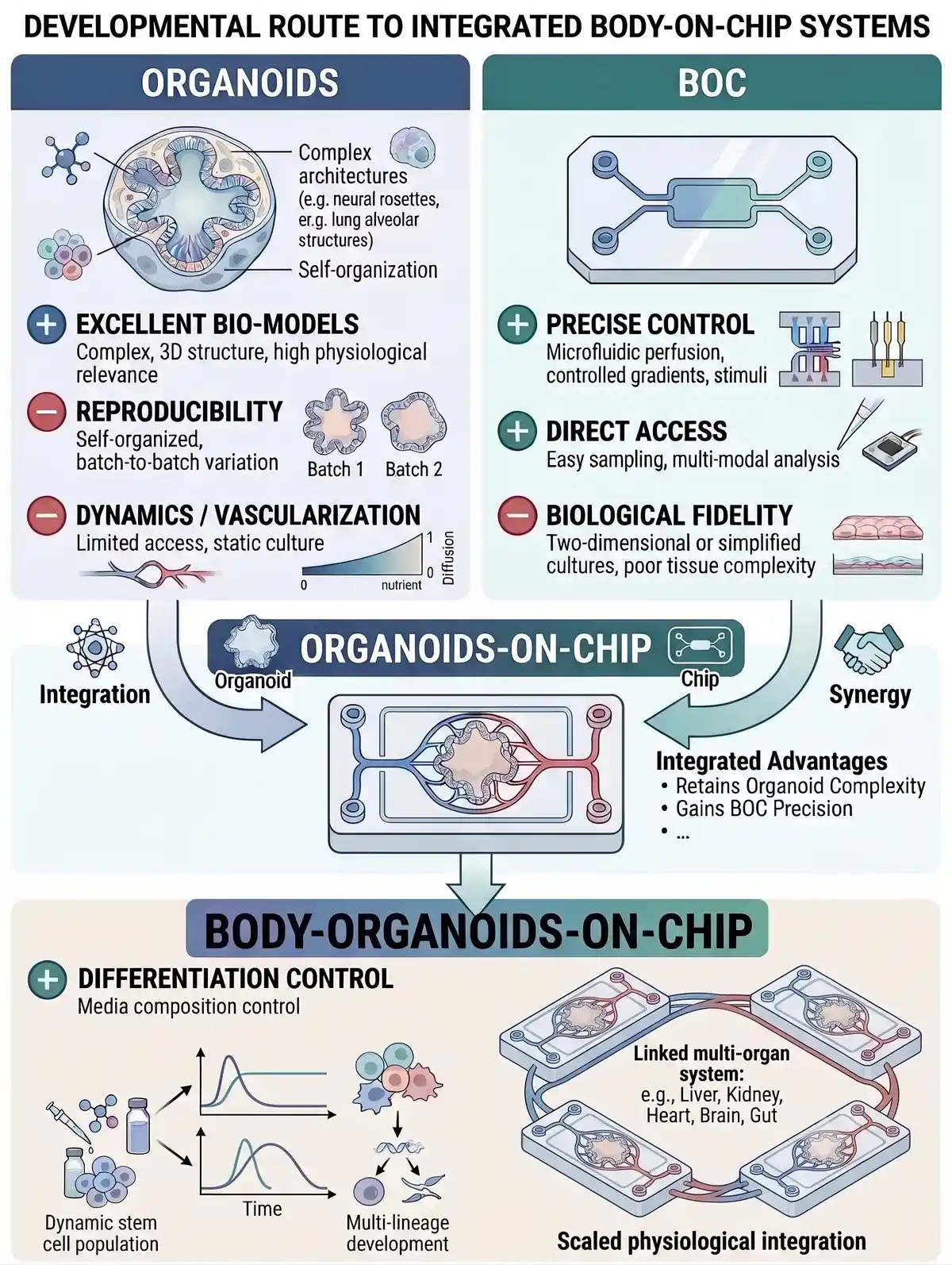 From organoids and organ-on-chip to integrated body-organoids-on-chip systems.
Quintard C, Ren J, Penninger JM. Building physiologically relevant multi-organ-on-chip systems. Nature Reviews Bioengineering (2026). doi: 10.1038/s44222-026-00496-6